A slow way to look at photographs.
Squareshot was created by Colin Summers as a way to feed digital photo frames - real ones, physical ones, the kind that sit on a shelf and change pictures while you're not looking.
It started with frames that could only display square-formatted images: Polaroid-style, one photo at a time, with a caption underneath. The constraint turned out to be the point. A single photograph, matted and captioned, asks for more attention than a feed ever does.
Everything about Squareshot is built around that idea. Photos are collected in shoeboxes, arranged into stacks, and displayed on frames. The pace is slow on purpose - a new image every twenty minutes. No infinite scroll, no timeline, no algorithm. Just one picture behind glass, and then another.
Hardware you can put on a shelf.
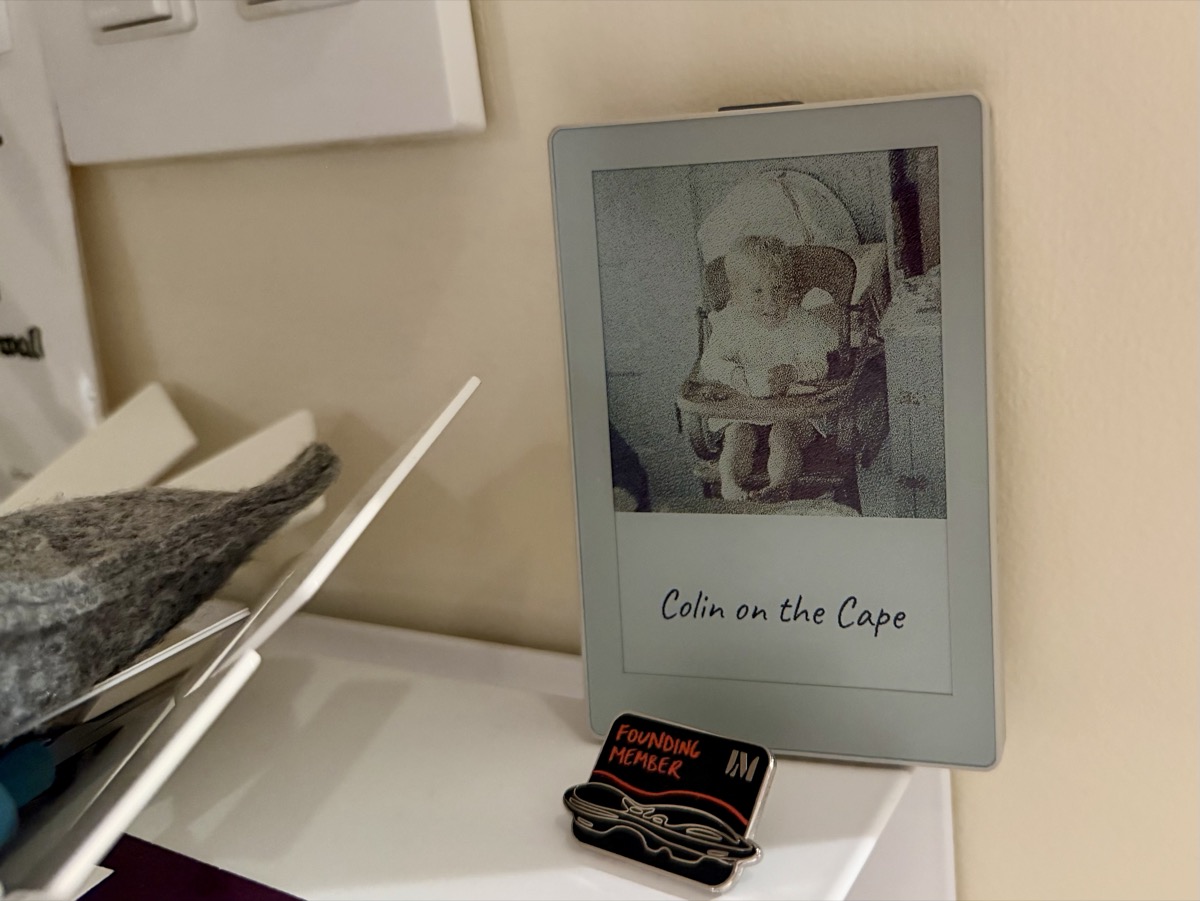
The first Squareshot frame was an M5Stack PaperColor - an e-ink display with a six-color Spectra panel. E-ink is a natural fit for a photo frame: the image stays on screen with no power at all, the display is daylight-readable, and it looks like a printed photograph rather than a glowing screen. The PaperColor connects to Squareshot over Wi-Fi, pulls a new image when the stack advances, and goes back to sleep.
The second frame target is the CCYD - an ESP32 paired with an ST7789 LCD panel, 320 by 240 pixels. These are sometimes called Cheap Yellow Displays. They are tiny, bright, inexpensive, and surprisingly capable. Where e-ink looks like paper, an LCD looks like a little jewel. Both have their charm.
And of course there's the web viewer - any browser can be a frame. But the physical displays are the heart of the project. A photograph on a shelf is different from a photograph on a laptop.